; Niggel: psychology

Designed by Veethemes.com | Gooyaabi

Latest Posts

Showing posts with label psychology. Show all posts
We don't perceive every single piece of information around us. Instead we must constantly fill in blanks in our knowledge to properly create a mental image of the world. This processes of filling in gaps is really important to understand and to exploit when crafting games.

At the very core, games are driven by systems. We have extremely powerful machines that can quite accurately simulate various forms of physics, economics, group dynamics, intelligence and so on. This means that at our fingertips are the tools to create entire worlds. It is therefore very tempting to use these in order to solve every single problem. But this is not always the best approach. Sometimes it's best to just leave gaps, and let the player's imagination handle the rest.

There are five core reasons why this is so:

  • We are all unique individuals with different needs and likes. By leaving things unsaid, players can personalize their experience without any asset requirements from the creator. A typical example is that players can envision the sort of monster they personally are the most afraid of.
  • It is impossible to simulate things on an atomic level; there always needs to be a cut-off at some level. Since highly complicated things tend be unstable and encourage scrutiny, it is often better to make the cut off at a higher level.
  • There are certain things which are, for various reason, not possible to implement properly. In this case a lot can be gained by simply leaving it to the imagination. This includes everything from creating immense battle scenes to conveying a particular emotional state.
  • For the sake of pacing; sometimes it's simply not possible to give the player all of the required information and it's better for them to just work it out for themselves. This could be things such as background story, details on a map, or the areas that it's possible to visit in a location.
  • There is an inherent enjoyment in filling out blanks in various forms of art. The reasons are a bit fuzzy, but you can clearly see it in all art. It's fun to wonder what a character is really feeling, what events lead to a scene, and to mentally picture what a shadow is hinting at.
All of this works because of how our brains is constructed. We are all equipped with highly capable pattern-matching machines. Our brains, and therefore we ourselves, want the world to make sense and will always try and fit things into a coherent and convincing narrative. The simplest example of this at work is motion.  Just consider this animation:

This is really just a series of circles that we see in rapid succession. Despite the fact that it's quite easy to notice the individual frames, we still see it as a ball jumping up and down. We fill in the gaps between the frames and see it all as an animation. Notice that this doesn't really take any conscious effort - it comes naturally. In fact, it is quite hard (possibly impossible) to not see this motion. When done right, gaps of the imagination never really feel like such - they simply get incorporated into the overall experience.

Here is another classic example:


There is no white triangle pointing downwards, but the other shapes suggest that there should be, and hence we see one. Again, this is something that we carry out automatically and while we can rationally understand that there really is no triangle, we cannot mentally unsee it.

Closing gaps like this is not just a fun side effect. It is a crucial way in which our brains function. Taking decisions on incomplete information is an essential skill in the function of our day to day lives. In fact, most of the information we receive is incomplete - it's quite rare that we are directly exposed to situations where we have all possible information to hand. So it's not so strange that closing gaps should come so naturally to us, we literally wouldn't be able to survive otherwise.

As I have said before, any decisions we make are based around a mental model. In our heads is a mental simulation of how we think the world works, and before we do anything we first run through the action in our model to see if it would have the effect we intend. However, it is not possible to get complete information about our surroundings. So in order to get a working map of the terrain we need to fill some of the information. That is what the gaps in imagination are all about - our process of crafting a working mental model.

Given that this is a foundational part of how people work, it is essential that we always have it in mind when designing games. After all, the end result of a game is really to create a specific mental model in the player. This can be done through direct system access, sensory input or, what this post is all about, through suggestions of something unseen.  I will now go over the most common, and most important, ways in which gaps can be used.

---

Sensory Gap
This is the most common one and also easiest to understand. When we are presented with sensory information that is somehow incomplete, we try and fit it into a working context. There are many different ways in which to do this. It can be quick, disjointed shots of something, events seen through the eyes of a monster, a character reacting to a smell. or a sound that is so loud it shatters glass. Normally you build this sort of gap up by presenting a negative space where one or more object/events/reactions/etc. all related to something unseen. 

We tend to use this sort of gap more than we realise, simply because it is such an ingrained way of working with various artforms. But that just means you have to be extra aware of how it works. For instance, it's good to know that we are extremely prone to seeing familiar shapes, such as faces, in just about anything. 

It's actually quite hard to not see anything in an image. We have evolved in an environment where there was nothing like pure noise, everything we saw was part of the environment somehow. Therefore, when we see random patterns the brain goes into overdrive to find a connection. Of course, it is not just the direct information received that we use to do this, but anything related is accessed as well. Because of this, you can often get away with very little if the scene is just set up in the right manner. Learning to do this is incredibly important.


Informational Gap
This is very similar to the sensory gap, but instead of sensory data it deals with information in the abstract. Jeff Vogel recently wrote a blog post on how games often have too many words [1], and properly using gaps is the best remedy for that. It is often easy to underestimate just how much information a player is prepared to fill out for themselves. You might think that a player really needs to know details of everyday routines in order to fully understand how a certain society functions. But often it is just as good to simply have some brief glimpses (visually or through text) of what they are doing along with something that sets the tone (music, animation, etc). 

This sort of advice might seem a bit obvious, but it is worth keeping in mind how good we humans are at filling out these sort of gaps in information, especially if it comes in form of gossip. Gossip is something that has probably been part of our lives since before we evolved into modern humans. We are social animals and gossip serves as a tool to keep track of the group we are living in. This means our brains are extra-sensitive to this sort of information, similar to seeing shapes and motion, and can easily assess even the smallest hints.


Spatial Gap
Games are often very spatial and requires the player to navigate various places. Because of this it is often very tempting to accurately represent every single area to give a proper sense of place. However, for various reasons this might not be feasible or required. It is then important to note that spaces can also be created from gaps, just as much as sensory information and lore. Spatial gaps are a bit trickier though as we are now messing with the actual play area which means you you have to be extra careful.

The sloppy way to implement is to simply have a lot of locked doors that the player cannot access. But this can be bad for pacing and, worse, it can lead to a weak mental model. The brain is usually quite lazy and will try to optimize. If the pattern becomes 'locked door equals the room is irrelevant', it will be noticed and incorporated into the model. After all, dismissing these spaces is much easier than assuming they are there.

Instead it is better to vary the ways in which the rooms are blocked off, and to build up a negative space hinting that it is there, such as glimpses into it from a small window. It is especially effective to make the player believe that room might contain something of value. That way it is much more likely it will be part of the mental model. Remember, what matters is not what is actually there, but what the player perceives to be there.


Causal Gap
This next time is very similar to the animation example from above, but happens over longer time scales. As I said before, closing gaps is all about creating a working mental model. Where the previous gaps where are all about what we see, causal gaps is more about why we see it. Just like we humans are quick to see familiar objects in random patterns, so are we quick to correlate two events with one another. A black cat runs over the street and then you get a headache. We humans often correlate the most strange occurrences and it is quite hard not to. Many of our psychological fallacies are really based around this fact, and it takes effort to learn not to do this. Why is this so? Because for our ancestors it was okay to have a few weird beliefs if it meant we could pick up on dangerous situations and survive better. If you are a skeptic about the cat causing the headache, you might also be skeptical towards the signals of an impending avalanche. 

This is obviously the sort of brain glitch that we can make use of in art. Film is a medium that uses it all the time, in editing. See a gun fire, and then a person being hit, and it is obvious what has happened. Correlating these two events into a single event comes naturally to us. But because games are so driven by the player understanding the flow of input and output, or how the player's actions correlate to events in the game world, it gets a bit harder to deal with gaps.

The simplest way to do it is with events taking place. For instance, say the player suddenly notices that a door is blocked, and hears the sound of feet running away. They will now assume that whoever is running away is also the one who blocked the door. 

A little harder is for us to provoke imagined causal connections from actual interaction. What I mean by this is that you actually leave out certain information when actions take place, and ask the player to fill in the middle. For instance, if I click on an object in a game and it simply pops into my inventory we would like the player to mentally simulate this as "I picked up the item" and not "the item got magically teleported into my inventory". The three key elements for achieving this are consistency, negative space and optimization-avoidance.

Consistency means that we need it to happen in a way that makes it possible to distil it into a couple of universal rules. For instance, is the distance you can pick up items at consistent with the player using their hands? Negative space means that we use other events to reinforce the fantasy. These can be sounds effects when you pick up, feedback messages when you are too far away, and cutscenes where we see this happening for real. Finally, optimization-avoidance means that our intended mental model, that of the player actually picking these objects up, must be the "simplest" [2] available explanation. If there are too many edge cases, weird behaviors or simply not enough supportive negative space the "magical teleportation"-theory will win.


Anticipatory Gap
This one is quite similar to causal, but worth having in its own category. These are basically events that might happen to the player in the future and that they will take into account when planning. As explained in an earlier blog, planning is a core reason why gameplay is engaging, and thus it is important to shape what sort of consequences the player can conceive of taking place. When the player plays a game, they will generate their mental models not just based on what they are playing, but also what they know from before. This is gives us an opportunity to make the player think certain things are possible, without them never having witnessed them.

Suppose that the player hears footsteps from afar. These might just be coming from a couple of scripted sound effects, but the player doesn't know that. Given the right context the player will conjure up a monster that is making these sounds and assume that it might attack them. Now the player will start making plans based on a few sound effects and project a lot more onto the game than what is actually there. This is something that we saw a lot in Amnesia. The player could create long, and engaging, gameplay situations for themselves only because of a few sound effects. 

Of course, this sort of trick can't last forever. As I have mentioned several times, the brain likes to optimize and once the pattern gets to clear the illusion will go away. So it is important to constantly update the negative space, to not make the events so predictable and to setup situations in ways that feel exciting to partake in. Even more important is to make sure that this trickery is not the only gameplay there is. If the player has a baseline of actual planning  and execution going on, this sort of illusory anticipation can be sustained for quite a long time and add a lot to the experience.


Agency Gap
If you are in the jungle and the high grass suddenly moves. Do you:
  1. Assume it is a tiger with the intention of eating you?
  2. Be skeptical and consider that it might just be the wind playing tricks?
In our ancient past, the people who thought like number 2 were much less likely to survive. Sure, they escaped the embarrassment of being afraid of grass from time to time. But they also got eaten a lot more by tigers. Thinking of events as being caused by something with agency (e.g. an animal) is powerful concept for survival. It is also something that leads to all sort of weird beliefs like tree spirits and demonic possession. For many events it comes naturally to think of them as caused by intentional beings. And once again, this is great stuff to use in games.

This video that is a great example of the whole thing in action. Just note how you directly project agency on the shapes.


The most common use of this is in enemy AI. Most of the time, AI that feels smart is because the player thinks it is so, not because the underlying systems are complex [3]. F.E.A.R. is a great example of this. While the AI does have some clever systems at play, it derives most of its impressiveness from being good at giving the player feedback. For instance, by saying "cover me" while a grenade is thrown, it gives the impression that much more is happening than what actually occurs. The player projects a set of thoughts running through the soldier's mind and incorporates that into their mental model. But in reality it is just very simple code that is executed.

This is an area where the brain works a lot to our advantage. We are ill-equipped to mentally simulate things like state machines, but it comes naturally to think in terms of people. This means that we can get a lot of content to the player only through suggestion. The player's brain is really apt at simulating people and can do so much better than any existing computer system. So the more of that power we can use, the better.

All of this get harder when we get away from combat though. While players want to think of other characters in games as entities with rich mental lives, there is a limit to how far they are willing to go. If animations start to look weird, if responses come out as canned or if interaction possibilities are too limited the brain gets lazy and optimization kicks in. Characters go from intentional beings to simply being objects.

A big problem of interactive storytelling is how to keep this from happening. Just as I discussed with causal gaps, the key elements in achieving this are consistency, negative space and optimization-avoidance. How exactly to achieve this with characters is still too unclear and complex to cover this time around - I will go over some possible directions in a future blog post.


Volition gaps
Finally we have arrived at the last gap type, which is similar to causal gaps. Previously we have mostly talked about things happening when the the player is the one causing it, but volition gaps contradict that. These are events that the player thinks they cause when in fact they don't.

This is something that I think currently is quite unexplored and has a lot of potential. It is quite hard to construct control interfaces that allows the player to take all the possible actions. Therefore it would be nice if we could have actions that the game does automatically but that the player believes they used their volition to cause. This is what this gap is all about.

Just like we construct a mental model of what is happening on the outside world we are also constructing a narrative of what we are doing ourselves. While we are not conscious about it in everyday life, a lot of the time we have reasons and beliefs because we do certain things, instead of the other way around.

For instance, take choice blindness. In an experiment the subject had to pick which face they thought were the most beautiful, and then when handed back a different picture, most subjects continued to explain why they had chosen it. So a lot of the time, we make up reasons based on the actions we find ourselves doing. And as always, whenever there is a brain deficiency, we should try and exploit it for art.

The best example of this effect in use is in Assassin's Creed. When you run across the roofs in a city, the game will automatically make the character jump. Despite that, it always feels like you are the one who is willing those jumps to happen. This works as a great way of streamlining the controls and making the experience more fluent without taking away a sense of agency in the player. Another example of is in games like Uncharted where the character will interact with the world in ways that make sense and enhance the feeling of being there.

I believe that these sort of gaps can be taken further, though. An interesting example of this is The Path, where the protagonist will carry out actions of their own choice when you leave them alone. It is by no means perfect, and doesn't really provide an illusion of volition. But I think it shows the potential of this and I think causes the player to feel intimately involved with various events if used correctly. Currently, though, it is too unexplored to say for sure what the possibilities really are. I will explore some more thoughts on this in a later blog post.

---

That should summarize the basics for the various gap types. I am sure there are even more than these, but this selection is what I found most useful for games. In upcoming blogs I will dig deeper into some aspects of this and give more examples on how it affects gameplay.

Until then I recommend reading Ian Thomas's excellent article on the subject where he discusses gaps for LARPs, SOMA, and much more.


Footnotes:
1) The follow-up post that looks at the game Pillars of Eternity specifically is also well worth reading:
http://jeff-vogel.blogspot.se/2017/06/games-have-too-many-words-case-study.html

2) This is simplest in terms of effort used by the brain, not in a strict theoretical sense. For instance "a witch did it" is a simple explanation for a human brain, but in reality is quite complex because it assumes a lot of attributes for the witch. But we as humans are great at just ignoring this, making the silly explanation seem simple.

3) This video shows it off nicely: https://www.youtube.com/watch?v=9bbhJi0NBkk
In this post I dig into planning, and how it is a fundamental part of what makes a game engaging. Planning affects many aspects of what is so special about games and why we enjoy playing them. This post will go over the reasons behind this, and explains why planning is so important for narrative games.

I think we can all agree that there is a difference in how certain games feel to play. There are just certain games that feel "gamier" than others. Just compare playing Super Mario to something like Dear Esther, and I think it's clear that the former feels like it has more gameplay than the latter. What is it that causes this? My hypothesis: the ability to plan.

The more a player can plan ahead in a game, the more engaging that game will feel to play.

Before I cover some evidence of why this is most likely true, I will need to get into some background information. In order to understand why planning has such a prominent role in games, we need to look into the evolution of our species and answer this question: why are fish so stupid?
---

This is how the world looks to the average fish:


They can really only see 1-2 meters in front of them and often it's even worse than that. This means that a fish can't do much planning. It just reacts to whatever pops up in front of its face; that's really what their lives are all about. If a fish's life was a game, it would be a limited version of Guitar Hero played to random noise. This is why fishing works. Fish don't think like us, they're mainly just driven by hardwired responses.

For a large part of earth's history this was what life was like for organisms. But then 400 million or so years ago something happened. Fish started to move on to land. Suddenly, the view looked more like this:


This changed their world. Suddenly it was possible to plan ahead and to properly think about your environment. Previously, smart brains had been a waste of energy, but now it was a great asset. In fact, so important was this shift that it is probably a big factor in how consciousness evolved.  Malcolm MacIver, who as far as I can tell originated this theory, writes about it like this:
"But then, about 350 million years ago in the Devonian Period, animals like Tiktaalik started making their first tentative forays onto land. From a perceptual point of view, it was a whole new world. You can see things, roughly speaking, 10,000 times better. So, just by the simple act of poking their eyes out of the water, our ancestors went from the mala vista of a fog to a buena vista of a clear day, where they could survey things out for quite a considerable distance. 
This puts the first such members of the “buena vista sensing club” into a very interesting position, from an evolutionary perspective. Think of the first animal that gains whatever mutation it might take to disconnect sensory input from motor output (before this point, their rapid linkage was necessary because of the need for reactivity to avoid becoming lunch). At this point, they can potentially survey multiple possible futures and pick the one most likely to lead to success. For example, rather than go straight for the gazelle and risk disclosing your position too soon, you may choose to stalk slowly along a line of bushes (wary that your future dinner is also seeing 10,000 times better than its watery ancestors) until you are much closer."
 To showcase the above, he has the following image:


This images nicely shows the conceptual difference in the processes involved. In one you basically just use a linear process and "react as you go". In the other one you scout the terrain ahead, consider various approaches and then pick one that seems, given the available data, to be the best one. 

It is not exactly the same, but there is a striking likeness to the following image comparing old school and more modern FPS design:

I know that this is not a completely fair comparison, but the important point here is that when we look at these two images, it feels pretty clear which of these two designs ought to have the best gameplay. The image on the left represents a more complex and interesting landscape, while the one on the right represent a linear sequence of events. And just like the worlds of a fish compared to that of the world of land animals, this means a huge difference in our ability to plan.

There are other interesting connections with the ability to see far and to plan. Malcolm MacIver replies to a question regarding the intelligence of octopi:
"It’s incredible what being an unprotected blob of delicious protein will get you after eons of severe predation stress. They, by the way, have the largest eyes known (basketball size in the biggest deep sea species). Apparently, they use these to detect the very distant silhouettes of whales, their biggest threats, against the light of the surface. 
The theory is committed to the idea that the advantage of planning will be proportional to the margin of where you sense relative to where you move in your reaction time. It then identifies one period in our evolutionary past when there was a massive change in this relationship, and suggests this might have been key to the development of this capacity. It’s interesting that octopuses and archerfish tend to be still before executing their actions. This maximally leverages their relatively small sensoria. There may be other ways, in other words, for animals trapped in the fog of water to get a big enough sensorium relative to where they are moving to help with planning."
Sight is of course not the only reason for us humans to have evolved our current level of intelligence and consciousness. Other important factors are our upright pose and our versatile hands. Standing up meant that we could see further and allowed us to use our hands more easily. Our hands are the main means with which we shape the world around us. They allowed us to craft tools, and in various ways to change parts of the environment to optimize our survival. All of these things are deeply connected to the ability to plan. Once we learned how to reshape the world around us, our options opened up and the complexity of our plans increased immensely. 

It doesn't stop there. Planning is also a crucial part of our social life. Theory of mind, our ability to simulate other people, is both a reason for and a product of our planning abilities. Navigating our social groups has always been a careful activity of thinking about various paths of action and their consequences. 

Planning also underlies two other phenomena that have been discussed recently on this blog: Mental Models and Presence. The reason why we have mental models is so that we can evaluate actions before we make them, which obviously is crucial to planning. Presence is a phenomenon that comes from us incorporating ourselves into our plans. We don't just want to model what happens to the world, but also to ourselves.

So, to sum things up: there are lots of evolutionary reasons why planning would be a fundamental part of what makes us human. It's a big part of who we are, and when we are able to make use of these abilities we are bound to find that engaging. 

---

So this background is all very well, but is there really any good evidence that this is actually a thing in games? Yes - in fact, quite a bit of it! Let's review the ones that I find the most important.

There is a model of player engagement called PENS (Player Experience of Need Satisfaction) which is quite rigorously researched. It uses the following criteria to evaluate what a player thinks about a game.
  • Competence. This is how well a game satisfies our need to feel competent - the sense of having mastered the game. 
  • Autonomy. How much freedom does the player have and what options do they have to express it?
  • Relatedness. How well is the player's desire to connect with other people satisfied?
Measuring how well a game performs on the above metrics has been shown to be a much better indicator of various types of success (sales, how likely people are to recommend the game, and so forth) than simply asking if the game is "fun". 

And, more importantly, two of the above factors are directly related to planning. Both Competence and Autonomy heavily rely on the player's ability to plan. Let's go over why this is so.

In order for a player to feel competent at a game they need to have a deep understanding of how the game works. Sure, there are games where mere reflexes are enough, but these are always very simplistic. Even in most rhythm games there are certain rules that the player needs to learn and understand in order to play well. A big part is also learning the melodies that make up each level. Why? In order to optimally place your inputs (be that fingers or feet) to hit as many beats as possible. All of these aspects boil down to one thing: being able to predict the future.

You see the same thing in most games. You get better at Darks Souls when you understand how monsters attack, how levels are laid out and how your own attacks work. Learning how a world operates and gaining the ability to predict is a cornerstone of competence. Sure, you also need to develop the motor skills to carry out the required actions, but this is almost always less important than understanding the whys and whens of the actions. Simply being able to predict is not enough, you also need to have a sense of what goal you are trying to achieve and then, using your predictive abilities, to carry out the steps required to reach it. Or in other words: you need to be able to plan.

Autonomy is also highly dependent on the ability to plan. Imagine a game where you have plenty of freedom, but have no idea how the game works. Everybody who has booted up a complex strategy game without understanding the basics knows that this is not very engaging. In order for the freedom to mean something, you need to have an idea what to do with it. You need to understand how the game's mechanics behave, what tools are at your disposal, and what goals you want to achieve. Without this, freedom is confusing and pointless.

So in order to provide a sense of autonomy a game needs to not only provide a large possibility space, but also teach the player how the world works and what the player's role in it is. The player needs to be able to mentally simulate various actions that can take place, and then come up with sequences that can be used to attain a specific goal. When you have this, you have freedom that is worth having. It should be pretty obvious that I am again describing the ability to plan. A world in which the player is not able to plan is also one with little autonomy.

Similarly, if the game only features a linear sequence of events, there's not much planning to be done. In order for the player to be able to craft plans there need to be options. This is not the case if only a certain chain of actions is possible. This scenario is a typical example of having no freedom, and unsatisfactory in terms of autonomy.  Again, planning and autonomy are intricately linked.

One could make the case that Relatedness also has a connection with planning. As explained earlier, any social interactions heavily rely on our ability to plan. However, I don't think this is strong enough and the other two aspects are more than enough. Instead let's look at evidence from a different angle.


One trend that has been going on for a long time in games is the addition of extra "meta" features. A very common one right now is crafting, and almost all big games have it in some way or another. It's also common to have RPG-like levelling elements, not just for characters, but for assets and guns as well. Collecting a currency that can then be used to buy a variety of items also turns up a lot. Take a look at just about any recent release and you are bound to find at least one of these.

So why do games have them? The answer to that is quite easy: it makes the game more engaging. The harder question is why that should be the case. It can't solely be because it gives the player more to do. If that was the case you would see games adding a random variety of mini games to spice things up. But instead we are seeing certain very specific types of features being used over and over again.

My theory for this is that it's all to do with planning. The main reason that these features are there is because it gives the player a larger possibility space of plans, and more tools to incorporate into their planning. For instance, the act of collecting currency combined with a shop means that the player will have the goal of buying a particular item. Collecting a certain amount of currency with a view to exchange it for goods is a plan. If the desired item and the method in which the coins are collected are both connected to the core gameplay loop, then this meta feature will make the core loop feel like it has more planning that it actually has. 

These extra features can also spice up the normal gameplay. Just consider how you need to think about what weapons to use in combat during The Last of Us. You have some scrap you can craft items from, and all of those items will allow you to use different tactics during combat. And because you cannot make all of them, you have to make a choice. Making this choice is making a plan, and the game's sense of engagement is increased. 

Whatever your views on this sort of meta-feature are, one thing is certain: they work. Because if they weren't we wouldn't be seeing this rise in them persist over such a long time. Sure, it's possible to make a game with a ton of planning without any of these features. But that's the hard way. Having these features is a well-tested way to increasing engagement, and thus something that is very tempting to add, especially when you lose a competitive advantage by not doing so.


Finally, I need to discuss what brought me into thinking about planning at all. It was when I started to compare SOMA to Amnesia: The Dark Descent. When designing SOMA it was really important for us to have as many interesting features as possible, and we wanted the player to have a lot of different things to do. I think it is safe to say that SOMA has a wider range of interactions and more variety than what Amnesia: The Dark Descent had. But despite this, a lot of people complained that SOMA was too much of a walking simulator. I can't recall a single similar comment about Amnesia. Why was this so?

At first I couldn't really understand it, but then I started to outline the major differences between the games:
  • Amnesia's sanity system
  • The light/health resource management.
  • Puzzles spread across hubs.
All of these things are directly connected with the player's ability to plan. The sanity system means the player needs to think about what paths they take, whether they should look at monsters, and so forth. These are things the player needs to account for when they move through a level, and provide a constant need to plan ahead.

The resource management system works in a similar fashion, as players need to think about when and how they use the resources they have available. It also adds another layer as it makes it more clear to the player what sort of items they will find around a map. When the player walks into a room and pulls out drawers this is not just an idle activity. The player knows that some of these drawers will contain useful items and looting a room becomes part of a larger plan. 

In Amnesia a lot of the level design worked by having a large puzzle (e.g. starting an elevator) that was solved by completing a set of spread out and often interconnected puzzles. By spreading the puzzles across the rooms, the player needs to always consider where to go next. It's not possible to just go with a simple "make sure I visit all locations" algorithm to progress through the game. Instead you need to think about what parts of the hub-structure you need to go back to, and what puzzles there are left to solve. This wasn't very complicated, but it was enough to provide a sense of planning.

SOMA has none of these features, and none of its additional features make up for the loss of planning. This meant that the game overall has this sense of having less gameplay, and for some players this meant the game slipped into walking simulator territory. Had we known about the importance of the ability to plan, we could have done something to fix this. 

---

A "normal" game that relies on a standard core gameplay loop doesn't have this sort of problem. The ability to plan is built into the way that classical gameplay works. Sure, this knowledge can be used to make such games better, but it's by no means imperative. I think this is a reason why planning as a foundational aspects of games is so undervalued. The only concrete example that I have found[1] is this article by Doug Church where he explains it like this:
"These simple, consistent controls, coupled with the very predictable physics (accurate for a Mario world), allow players to make good guesses about what will happen should they try something. Monsters and environments increase in complexity, but new and special elements are introduced slowly and usually build on an existing interaction principle. This makes game situations very discernable — it's easy for the players to plan for action. If players see a high ledge, a monster across the way, or a chest under water, they can start thinking about how they want to approach it. 
This allows players to engage in a pretty sophisticated planning process. They have been presented (usually implicitly) with knowledge of how the world works, how they can move and interact with it, and what obstacle they must overcome. Then, often subconsciously, they evolve a plan for getting to where they want to go. While playing, players make thousands of these little plans, some of which work and some of which don't. The key is that when the plan doesn't succeed, players understand why. The world is so consistent that it's immediately obvious why a plan didn't work. "
This is really spot on, an excellent description of what I am talking about. This is an article from 1999 and have had trouble finding any other source that discuss it, let alone expands upon the concept since then. Sure, you could say that planning is summed up in Sid Meier's "A series of interesting choices", but that seems to me too fuzzy to me. It is not really about the aspect of predicting how a world operates and then making plans based on that.

The only time when it does sort of come up is when discussing the Immersive Sim genre. This is perhaps not a big surprise given that Doug Church had a huge part in establishing the genre. For instance, emergent gameplay, which immersive sims are especially famous for, relies heavily on being able to understand the world and then making plans based on that. This sort of design ethos can be clearly seen in recent games such as Dishonored 2, for instance [2].  So it's pretty clear that game designers think in these terms. But it's a lot less clear to me that it is viewed as a fundamental part of what makes games engaging and it feels like it is more treated like a subset of design.

As I mentioned above this is probably because when you take part in "normal" gameplay, a lot of planning comes automatically. However, this isn't the case with narrative games. In fact, narrative games are often considered "lesser games" in the regard that they don't feature as much normal gameplay as something like Super Mario. Because of this, it's very common to discuss games in terms of whether you like them to be story-heavy or gameplay-heavy, as if either has to necessarily exclude the other. However, I think a reason there is still such a big discrepancy is because we haven't properly figured out how gameplay in narrative games work. As I talked about in an earlier blog post, design-wise, we are stuck at a local maxima.

The idea that planning is fundamental to games presents a solution to this problem. Instead of saying "narrative games need better gameplay", we can say that "narrative games need more planning".

---

In order to properly understand what we need to do with planning, we need to have some sort of supportive theory to makes sense of it all. The SSM Framework that I presented last week fits nicely into that role.

It is really best to read up on last week's blog post to get the full details, but for the sake of completeness I shall summarise the framework here.

We can divide a game into three different spaces. First of all we have System space. This where all the code is and where all the simulations happen. The System space deals with everything as abstract symbols and algorithms. Secondly we have the Story space which provides context for the the things that happen in the System space. In System space Mario is just a set of collision boundaries, but then when that abstract information is run through the Story space that turns into an Italian plumber. Lastly, we have the Mental Model space. This is how the player thinks about the game and is a sort of mental replica of all that exists in the game world. However, since the player mostly never understands exactly what goes on System space (nor how to properly interpret the story context), this is just an educated guess. In the end though, the Mental Model is what the player uses in order to play the game and what they base their decisions on.

Given this we can now start to define what gameplay is. First of all we need to talk about the concept of an action. An action is basically whatever the player performs when they are playing the game and it has the following steps:
  1. Evaluate the information received from the System and Story space.
  2. Form a Mental Model based on the information at hand.
  3. Simulate the consequences of performing a particular action.
  4. If the consequences seem okay, send the appropriate input (e.g. pushing a button) to the game.
A lot of this happens unconsciously. From the player's point of view they will mostly view this sequence as "doing something" and are unaware of the actual thought process that takes place. But really, this always happens when the player does something in a game, be that jumping over a chasm in Super Mario or placing a house in Sim City.

Now that we understand what an action is, we can move on to gameplay. This is all about stringing several actions together, but with one caveat: you don't actually send the input to the game, you just imagine doing so. So this string of actions are built together in mental model space, evaluating them and then if the results feel satisfactory, only then do we start to send the required input.


Put in other words: gameplay is all about planning and then executing that plan. And based upon all of the evidence that I showed above, my hypothesis is: the more actions you can string together, the better the gameplay feels.

It isn't enough to simply string together any actions and call that a plan. First of all, the player needs to have an idea of some sort of goal they are trying to achieve. The actions also need be non-trivial. Simply having a bunch of walking actions strung together will not be very engaging to the player. It's also worth pointing out that planning is by no means the only thing that makes a game engaging. All other design thinking doesn't suddenly go out the window just because you focus on planning. 

However, there are a bunch of design principles that go hand in hand with planning. For instance, to have a consistent world is crucial, because otherwise it isn't possible for the player to form a plan. This is why invisible walls are so annoying; they seriously impede our ability to create and execute plans. It also explains why it's so annoying when failure seems random. For gameplay to feel good, we need to be able to mentally simulate exactly what went wrong. Like Doug Church expressed in a quote above: when a player fails they always need to know why.

Another example is the adventure game advice that you should always have several puzzles going at once. In planning terms this is because we always want to make sure the player has ample room to plan, "I will first solve this and then that". There are lots of other similar principles that have to do with planning. So while planning is not the only thing that makes a game engaging, a great number of things that do can be derived from it.

Let's quickly look at some examples from actual games.

Say that the player wants to assassinate the guy in red in this situation. What the player does not do is simply jump down and hope for the best. They need to have some sort of plan before going on. They might first wait for the guard to leave, teleport behind the victim, and then sneak up and stab them. When that's done they leave the same way they came. This is something the player works out in their head before doing anything. It isn't until they have some sort of plan that they start acting.

This plan might not work, the player might fail to sneak up on the guy and then he sound an alarm. In this case the plan breaks, however that doesn't mean that the player's plan was totally untrue. It just meant they didn't manage to pull off one of the actions of. If presented properly, players are okay with this. In the same way, the player might have misinterpreted their mental model or missed something. This is also okay as long as the player can update their mental model in a coherent fashion. And next time the player tries to execute a similar plan they will get better at it.

Often this ability to carry out your plans is what makes the game the most engaging. Usually a game starts out a bit dull, as your mental models are a bit broken and the ability to plan not very good. But then, as you play, this gets better and you start stringing together longer sets of actions and therefore having more fun. This is why tutorials can be so important. They are a great place to get away from that initial dullness by making the experience a bit simpler and guiding the player to think in the correct manner about how the game works.

It's also worth noting that plans should never be too simple to carry out. Then the actions become trivial. There needs to be a certain degree of non-triviality for engagement to remain.

Planning doesn't always need to happen in the long term, it can also be very short term. Take this scene from Super Mario, for instance:


Here the player needs to make a plan in a split second. The important thing to notice here is that the player doesn't simply react blindly. Even in a stressful situation, if the game works as it should, the player quickly formulates a plan and then tries to carry out that plan.

Now compare these two examples to a game like Dear Esther:


There are a lot of things one can like about this game, but I think everybody agrees that the gameplay is lacking. What's harder to agree on, though, is what's missing. I've heard a lot about the lack of fail states and competitive mechanics, but I don't find these convincing. As you might guess, I think the missing ingredient is planning.

The main reason that people find Dear Esther unengaging is not because they cannot fail, or because there is nothing to compete against. It's because the game doesn't allow them to form and execute plans. We need to figure out ways of fixing this.

By thinking about the planning in terms of the SSM-framework we get a hint at what sort of gameplay that can constitute "narrative play": When you form a plan in Mental Model space it is important that the actions are mostly grounded in the data received from Story space. Compare the the following two plans:

1) "First I pick up 10 items to increase the character X's trust meter, this will allow me to reach the 'friendship'-threshold and X will now be part of my crew. This awards me 10 points in range combat bonus."

2) "If I help out X with cleaning her room, I might be able to be friends with her. This would be great as I could then ask her to join us on our journey. She seems like a great sharpshooter and I would feel much safer with her onboard."

This is a fairly simplistic example, but I hope I get the point across. Both of these describe the same plan, but they have vastly different in how the data is interpreted. Number 1 is just all abstract system-space, and the number 2 has a more narrative feel, and is grounded in the story space. When the gameplay is about making plans like the second example, that is when we start to get something that feels like proper narrative play. This is a crucial step in evolving the art of interactive storytelling.

---

I believe thinking about planning is a crucial step in order to get better narrative games. For too long, game design has relied on the planning component arising naturally out of 'standard' gameplay, but when we no longer have that we need to take extra care. It's imperative to understand that it drives gameplay, and therefore that we need to make sure our narrative experiences include this. Planning is by no means a silver bullet, but it's a really important ingredient. It's certainly something that we're putting a lot of thought into when making our future titles here at Frictional Games.


Footnotes:

1) If anyone has other concrete resources describing planning as a fundamental part of games I'd love to hear about them. Please post about them in the comments if you know any.

2) Steve Lee had an excellent lecture called "An Approach to Holistic Level Design" at this year's GDC where he talked a lot about player intentionality. This is another concept closely related to planning.
Do videogames really have to try to tell stories? Are they not just better off focusing on interactive systems and gameplay? In this post I argue that stories are fundamental to the play experience by supplying context. This story context is crucial in order for videogames to engage and make the gameplay easy to grasp.

For ages there's been an argument going on about what part stories should play in videogames. Over time stories in games have gained more acceptance, but the discussion still continues. For instance, Ian Bogost recently wrote this article where he asked why you should make a game out of a story when you might as well make a movie or write a book.

This "go write a book instead" attitude isn't new. One of my favorite articles on the subject is Jesper Juul's "Games Telling Stories?". Interestingly, I pretty much agree with all of the points that Juul raises, but reject most of his conclusions. I think that video games are very well suited for telling stories and that there is no inherent conflict. Where I fully agree with Juul is on the argument that if you just take stories as we normally see them on film or in books and apply them to games, there will be a lot of friction. In order to make stories work in games you need to consider them in a different way.

The "go write a book instead" response is usually provoked by the fact that a game's attempt at storytelling disrupts the flow of the game. The most common example of this is when you need to watch some lengthy cutscene before you can continue playing. Problems also arise when juxtaposing gameplay and story gives rise to ridiculous inconsistencies, such as characters that can take hundreds of hits in-game being easily hurt in a cutscene. But this isn't evidence of stories being inherently unsuitable for games, these are just examples of sloppy implementation.

Stories are, in fact, crucial for videogames, and this has been the case almost since the earliest days of gaming history. They provide something vital to the experience: context. You can clearly see this in cabinets of early arcade machines, for instance this one for Asteroids:


The images are there to tell the player: "Those badly drawn circles coming at you are asteroids! Deal with them or perish!" This may be a really simplistic story, but it certainly is one. It gives the player a mental model of what is taking place on the screen, which allows them to intuit the workings of the world and to build a personal narrative. "I barely escaped getting crushed by an incoming asteroid!" is a much more interesting fantasy than simply thinking about the game in abstract. "I made the arrow-shape move out of the way for the incoming polygon thereby avoiding the game's fail state" doesn't come as naturally to us. In fact, it's quite hard to think of events in that manner. Take a look at this video:


You instantly think of the shapes as having intentions and personalities. Our brains are wired to do so, and the cabinet art of Asteroids taps into that. It also raises an interesting question: if humans are so prone to see stories in abstract shapes, do we really need any actual story content at all? This might seem a tempting conclusion, but there are a number of reasons it's misguided. For example:
  • It provides the player with an idea of what the game is about before they even start playing. Explaining Asteroids using abstract systems is non-trivial. Saying "you control a spaceship that has to avoid or blow up incoming asteroids" makes immediate sense.
  • It puts the player in the proper mindset from the get-go. This way we don't have to wait for a bunch of gameplay to unfold in order for the player to shape a suitable fantasy for it.
  • The fantasy is more likely to be coherent with the actual gameplay. If you just leave everything to the player's imagination, there may be later aspects of the game that contradict this, causing big problems as the player's mental model would contradict the concrete implementation of the game's systems.
  • While people are good at constructing fantasies it doesn't mean they don't need any help. Story-based context acts as a very potent catalyst for the player's inherent capabilities. If delivered properly, the result is a much deeper fantasy than the player could have made up on their own.
However this doesn't mean that you need to fill in all the blanks with story context. In fact, by leaving certain bits to the player's imagination the result can be even better. The trick is to know which parts to leave blank and which ones to fill in.[1]

It isn't just shooters with basic polygonal graphics that benefit from story context. Even adventure games, known for their strong story focus from the get-go, have similar roots to that of Asteroids. The first adventure game, Colossal Cave Adventure, started out as a simulation of a cave. In order to make the experience more interesting, Dungeons-and-Dragons-inspired events and puzzles were added to the mix. Again, the story was there to provide context to the basic experience - in this case exploring a cave system. Instead of just randomly wandering through a cave the player was now on a mission to search for a treasure and to avoid dangers that lurked in the darkness. This not only makes the experience more engaging, it also makes it easier to understand.

The case I want to make is that stories are incredibly potent for setting up play. Story is not just optional window dressing. By telling the player a story it makes it much easier for the player to engage. We as humans also grasp problems a lot more easily when they are presented as a narrative [2]. It enables us to use various built-in mental faculties to approach the problems and to figure out solutions. Understanding the dynamics of two factions that are at war comes naturally to us. When you pose the same problem in the form of mathematical equations it might require years of study to grasp the basic concepts involved. Human relationships come naturally, maths doesn't. This makes story context an indispensable part of game design.

Asteroids can get away with a really simple story because it is such a simple game. But games haven't stayed that simple, and as they grew more complicated, the story context needed to become more complicated as well. If you want the player to play as a spy infiltrating an evil organisation, simple polygons and cabinet art will not be enough. You need to add more details to your story context in order for the game's actions to make sense, be engaging, and easy to grasp.

Story isn't just something that has been slapped onto games because videogame designers have hidden desires to be film directors or novel authors instead. They are there there because they are crucial to the end experience. Sure, there are games that have pretty much zero story content - Tetris is a prime example. But these games are also very straightforward and possible to grasp based on very little play time.  The moment you want anything more complicated, story context comes naturally and becomes an ubiquitous part of conveying the game's intentions and forming a coherent experience.

It's similar to how kids play. Give them some sticks and stones and they will instantly use them in some sort of story context. Sure, they could just build stone and stick structures for the inherent enjoyment of it, but it's much more fun to think of them as castles, soldiers and a grand battle taking place. This is inherently human and permeates many more areas than just videogames and child's play. For instance, it's common to show backstories of the athletes before a sporting event in order to make the actual competition more exciting. News reporting also follow a similar pattern. Whatever the area is, the reason for having stories is the same: it provides context that makes the actual activity or content more exciting and relatable.


The idea of stories as context for play is even true for a game like The Walking Dead. In this game the player has little actual gameplay, and most of the time you just sit and watch. However, the hours of cutscenes are really just there to give context to the choices that the player eventually has to make. This might sound a bit weird, but if you think about it from a gameplay perspective it makes a lot of sense. The abstract systems that power the dialog selection wouldn't have much meaning if it weren't for the cutscenes preceding them.

You can even say that The Walking Dead requires the cutscenes for its gameplay to work. The gameplay in this case is simply making selections from a set of options that pop up on the screen. It's quite clear that abstract shapes and some cabinet art will not do the trick here. Your story context must be quite elaborate for the player to intuitively grasp and feel engaged by a simple "select the right option" process.


The same thing is true for games like the recently released What Remains of Edith Finch (which Bogost bases much of his argument around in his article). Much of the content in this game can be seen as the context for the character vignettes that you play from time to time. Without all of the intricate setup that the game has, these playable sections would have been a lot less engaging and harder to understand. In fact, it's actually quite likely that making these vignettes of gameplay was one of the major cornerstones in the game's development process. A similar process was at least true for SOMA. We started the development of it with the intention of making a few distinct scenarios playable. Much of the game was then built around that goal.

So when I say that the cutscenes in The Walking Dead are just context for the choice scenes, I am not just making a silly argument. In many cases, this is really how it works. Obviously, development is by no means this rigid, nor do I think many developers think consciously about it. Reality is always way more messy than theory. But that doesn't mean that this division is untrue. I think it's a really valuable way of looking at gameplay versus story.

It's also really important to note that this doesn't mean that context is just a superfluous aspect of the game experience. The story context can be engaging in its own right, and it is almost always beneficial if it is. But that doesn't take away the fact that the story content is there to provide context for the play. In fact I think it is crucial that we realize this as it clears up a lot of confusion around video game storytelling.
  • Story is not just plot, a sequence of events; it is whatever story content that provide context to the play experience. The setting, characters, themes and so forth all have part in this. In order to create a proper context there may be a need to tell a certain sequence of events, but it is by no means a requirement. This is where storytelling in video games and film/novels/etc. diverge and it is crucial to keep this in mind.
  • When it feels like a game has poor storytelling, it's not the same as it being unnecessary. The question to ask is: "Could there have been a better way to provide story context?". The problem is not that the game tries to focus on its characters, the problem is that the game is bad at providing the necessary context in an efficient and engaging manner.
  • Games are not trying to "tell deeper stories" compared to film or novels. They are trying to provide deeper thematic play. A core part in achieving this is by putting more focus on the story context. This is a very different goal from that of other media and to say "you might as well write a book" is to gravely misunderstand the challenge at hand.
Obviously context and play aren't simply two separate things. Context very often has a big part in influencing what sort of gameplay is best suited to it, and there may even be gameplay created with the sole purpose of influencing a certain bit of context. 

For me the most interesting question at this moment is: when it comes to evolving storytelling in videogames, what is the relationship between context and play? How can we set up context in such a way that it's the play that does the bulk of the actual storytelling?

I think this is a problem in many story-heavy games. There may be a lot of well-told story in them, but it's delivered in the form of cut-scenes, dialog, written notes, and so forth. I don't get to actually play it. This is also where I think seeing story as context comes as handy. It makes it evident that "classical story" in games is not an end goal in itself, but a framework, there in order to enhance the experience of play. To be better at understanding how this works and how to build experiences around it is where I see the future of interactive storytelling.


Footnotes:
[1] I will go deeper into this in a future blog post.
[2] Here is a really good example of this.
The reality that we sense in front of us is a fiction created by our brains. A host of modules process information in various ways and the end result is a mental model of the outside world. Knowing how this works is crucial to game development as the shape of these mental simulations has a huge effect on how a game feels and plays.

Look around the room or the place you are currently in. It certainly feels like what you are seeing is really there, right? However, that's not really the case. Reality is in fact made up by subatomic particles that constantly exchange various force particles amongst each other [1]. What you think of as a chair is really just a collection of particles that happen to form a temporarily semi-stable configuration. The reason why you see it as a chair only has to do with how your brain chooses to process the various data that it collects through its senses.

In the previous post on presence I mentioned how the brain is made up of modules, each of them having their own specific purpose. The results from these various modules are then used to form a collective image of your surroundings. For instance, there is a particular module that recognizes faces and, if damaged, it can no longer recognize people - the person affected will only see an object made up of some hair, a nose, two eyes and so forth. Recognizing individual people will only be possible if they have a particularly stand-out feature, like a large beard. Apart from that, all faces will look alike to this person. The normal flow of information is broken and something that most of us take for granted, an intrinsic part of our reality, is no longer present.

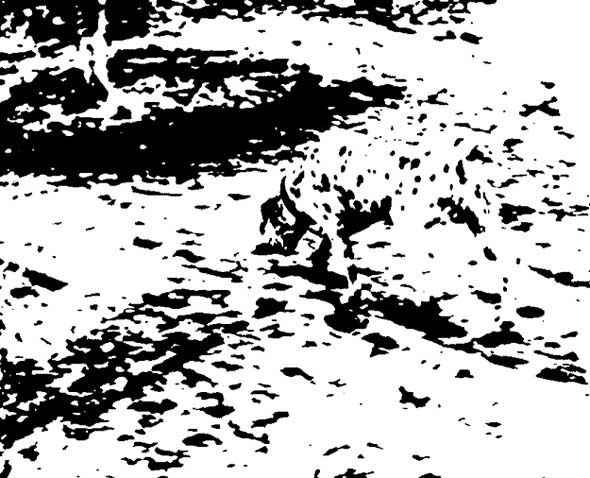
This is an extremely important point and it's essential to fully grasp it. It's not as if people who lose the ability to see faces still really see faces but don't "recognize" them. This is the good old "homunculus in the head" fallacy. When you look at the world around you, you are not really seeing details. You are being fed a stream of information and that stream contains things like "that is a chair", "the chair is made of wood", "that is the face of your mother", and so on. If the brain module that does the processing needed for a particular piece of information is damaged, it's not like your "mental view" remains the same - information is what your mental view is made up from. To get a better idea of this, look at this image:


When first looking at it, most people see this image as simply a collection of dots. But if you look carefully for a bit you will see the form of a dog appearing. Once you have managed to spot this dog, it becomes impossible to unsee. Your brain has gone from interpreting the image as a collection of dots to seeing it as a dog. If you were to lose a brain module this process would be reversed. What was once an image of a dog would turn into a collection of dots. The dog would not still "be there" - it would be erased from your perception of reality.

Your view of reality is not what reality is like, it is a mental simulation based on interpretations of data collected by your senses. You are really living your life in a sort of virtual world that the brain constructs for you [2].

This doesn't mean that your view of reality is a complete lie, though. It is still based on things that do exist and is a crucial tool for getting around and being able to make decisions. Even though a chair is a made up concept with no basis in reality, it still is very useful. It tells you something about what to expect and what your options are. For instance, if you are presented with either sitting down on a chair or on a pile of broken glass, your mental simulations are invaluable and can quickly give you pretty accurate estimates of what sitting down on each of the alternatives would mean. Note that these mental simulations are not confined to a single aspect of an object. There are things like shape, materials, current light conditions, the physical dimensions, emotional attachment, ownership and many other things that are all connected to an object. When you focus your gaze on an object, that is what you "see" - not some crystal clear pixel-by-pixel representation.

This array of properties is not always correct, though. For instance, if you try and pick up a carton of milk that your brain has modeled as filled (=heavy) and it turns out to be empty (=light), you will lift it with way too much force. But most of the time, because of the practice you've had at experiencing reality, your brain is pretty good at providing a good simulation.

Contra (1987)

Let's move on to games. When you are playing a game, you are not playing the game that is presented on the screen. You are playing the game that you are currently modelling in your mind. The brain turns clusters of pixels into abstract icons (eg "a power-up") and then attaches all sort of concepts to them. Just in the same way as it does when you encounter a chair in real-life. The modules in your brain use pre-existing knowledge and experience from interacting with the game and build up a mental model of how it is all connected.

The best example I know of this is from Brian Upton's book "The Aesthetics of Play". In the book he presents the example of navigating an environment in a game. What doesn't happen is that the player bumps into every wall and object, trying to figure out the bounds of the simulation. Instead the player analyses the scene in front of them and then mentally figures out a path to follow. This means that there is a lot of gameplay that takes place inside the player's head. In fact, unless the player is actively trying to test the systemic bounds of the game, almost all gameplay happens within the player's mental simulation of the game.

What all of this means is that is that we should be less concerned about the data (images, sounds, etc) that we send to our players and focus more on the sorts of mental simulations it gives rise to. This is an extremely important aspect of game making, and it has far-reaching consequences. No matter how much more realistically you render an object, it doesn't matter if the player's mental model chooses to represent it as something else.

The mental model is closely linked to our ability to anticipate. This is something that happens in all kinds of media [3]. For instance when watching a film and a character steps on a banana peel, we predict that they will slip and fall. As we see the foot approaching the banana our brain is already simulating possible outcomes and various filmic tricks, such as editing, are based around this happening in our minds. All mediums rely on this, but creating anticipation in games is extra tricky because of interaction.

In order for us to work with this we need to learn how these mental models are formed. There are three basic ways in which this happens: by using built-in knowledge, extrapolating from past experiences or learning through experimentation. These three modes complement one another, but it is useful to start by looking at them one at a time.

Built-in Knowledge
This is what our brains come equipped to deal with when we are born. They're essential to a human and you can pretty much assume that anyone playing the game will have them. Basic things like shape, lighting, perspective and so forth are all part of this category. It also includes behaviors like how pouring the content of a large glass into a smaller one will cause it to overflow, rotation of 3D shapes and how objects ought to act if you drop them. Social things like facial expressions are also part of this sort of knowledge. The facial expression connected to disgust is universal, hardwired, and does not depend on mimicking.


The one thing you need to realize about any built-in knowledge is that it's extremely hard to break. It takes a lot of effort to convince a person that dropping a ball will make it fall upwards. It is basically impossible to make a person intuitively see a mad face as a positive response. This is all hardwired knowledge that comes with equally interesting pros and cons.

If you can tie some basic functionality of your game directly to some built-in knowledge then it will instantly come off as intuitive to any player. For instance, if you want the player to feel disgusted by an enemy it's good to know that disgust is a disease-avoiding behavior. This knowledge allows you to trigger built in responses and also suggest what sort of events and interactions will strengthen a mental model that gives rise to feelings of disgust.

On the contrary, if your gameplay relies on something that goes against built-in knowledge, you either need to be prepared to spend a lot of time building the proper mental model or to ditch the concept altogether. Sometimes it is of course OK to break the rules, but remember that conforming to built-in knowledge is what makes a world seem believable. And if you want to focus on evoking basic human emotions, this basic believability is crucial. Without that you also lose a bunch of connections which are foundational to our emotional world.


Past Experiences
This is a huge area and it includes everything the player has learned throughout life. It is also something that can vary culturally. What I will focus on right now are two parts of this: past experiences with games versus past experiences with real life.

When you are first presented with a scene in the game there is a ton of stuff for you to process. If you see a red barrel and you have played games in the past, there is a big chance that you will think the barrel will explode when being shot upon. This interpretation relies on more than simply having encountered this specific object before. It relies heavily on what sort of game you are playing (point and click behaves differently from a quake-like shooter), what actions you think are possible (can you shoot it?), and so forth. So players come in with a lot of expectations and preconceptions on how things ought to behave. All of these will not just change how the player feel about the game, they will directly affect how the player think the game actually is like.


A monster can either be a horrible threat that you wanna keep away from, or it can be the source of what makes the game fun in the first place. The view the player takes directly affects how they behave and also has a long reaching effect on the experience of playing the game. For instance, in our game Penumbra the player has the ability to use weapons but they are very weak and inefficient. For players that interpreted the game as one where you'd best avoid any monsters, this worked great and they used the weapons as a last desperate effort to escape - as we had intended. Their mental model was one where the weapons and monsters were just like in real life. For other players the game was interpreted as a one where you could fight back. For these players it didn't work at all. The weapons felt frustrating to use and the monster was an annoyance. Their mental model was based on how videogames usually work. Despite interacting with the same system, seeing the same visuals and hearing the same sound, these two types of players experienced radically different games.[4]

To combat this in Amnesia: The Dark Descent we started the game with a quick notice on how the game was supposed to be played. This, together with other design changes of course, made a huge difference in how players approach the game. Unlike built-in knowledge, things learned from past events are quite malleable and it is possible to adapt them according to new situations. Which leads us to the final foundational way in which mental models are formed.

Experimentation
From the moment we are born (and possibly even earlier) our brains are hardwired to analyze, generalize and make assumptions. Whenever we encounter a new object we try it out in a variety of ways (squeezing, chewing, throwing, etc) in order to figure out what it is like. We then store that information and pull it out whenever we encounter a similar object. Everyone who has been near a small child knows about this process, and so does everyone who has played an unfamiliar game.


As noted before, the moment we see a scene from a new game, we make a whole load of assumptions of what everything is like and how it functions. But it is not until we get to interact with the scene that our assumptions get confirmation and are cemented. Unless the game is similar to another game we've already played, we know that we have new lessons to learn. These first impressions are crucial to how the rest of our experience is shaped [5]. This is why the opening of a game is so important. If a player gets the wrong idea about something it can be really hard to get rid of that faulty mental model.

Once the player interacts with something it will tell them about some aspect of the object. For instance, if they can pick it up or not. The player will then try to generalize this knowledge, often by using pre-existing information. So if a glass bottle can be picked up, they will assume that it's possible to pick up plastic bottles as well. Furthermore, if you throw a glass bottle and it breaks, it means the player will assume that everything made of glass is breakable. And so the experimentation continues as the game is played. Every new aspect is connected to other things the player already knows and an increasingly detailed mental simulation is built. The next time the player finds a bottle lying around,  a lot of attributes will be assumed the moment it comes into view.

---

The basic gist of the above shouldn't be too surprising, as it's pretty basic stuff. But the key thing to remember here is that these are not just things that form opinions. They form actual reality for the player.

To be able to look at an object and assume a bunch of attributes is what makes the world feel alive. It allows the player to use their hardwired brain faculties to explore, interact and make plans. The world might be rendered using toon shaders and feature talking rabbits, but if it allows for a rich mental model it will feel "real". Remember, it isn't about the objective facts of what you see (eg a teapot using highly realistic PBR-based shading), but what processing it gives rise to.

In order to make this happen, you can't just put objects and interactions into a world at random. The player must be able to explore the elements of the world, and in doing so they must be met by a consistent set of rules. The brain doesn't have an infinite amount of resources, and will therefore optimize when possible.

So if an object looks like something found in the real world, but you are unable to interact with it, it will not be given any further attributes. As it isn't of any importance, it will simply become part of the background. In a similar vein, the simplest explanation will also be used when possible. If there are ten keys lying on a table, but only the one that unlocks the door can be picked up, then players will stop modeling these objects as any sort of real keys. They will instead be seen as quest items, possible to pick up when it is convenient for the designer. When there's no consistency of any sort, the player's brain will just skip trying to do any modeling and rely on direct experimentation when needed (trial and error, basically). In these cases, players will have a very fuzzy mental model of an object and the object won't feel very "real".

An important aspect of this is that it's not always a bad thing that the brain optimizes away things. For instance, if you are making a simple shooter you don't really need to take any wall ornaments into account. You should just focus on the overall layout and the positions of the monsters. Everything else is a distraction.

It is, however, crucial to keep all of this in mind. There may be many cases where you don't want the player to optimize away certain objects. If you want the player to feel like the environment is a real place, you really need to make sure that as many details as possible can have intricate attributes in the player's mental simulation. It becomes even more important for characters where you want the player to model internal emotions, needs and goals. If your goal is to make the player feel like they are encountering real people, you want those people to be part of their mental model. This is what it means to make something feel real and alive.

All of this doesn't mean that one's goal should be to model everything in as detailed a way as possible. In fact, in many cases this may be counterproductive. Details could mean the player makes more assumptions, leading to the structure being more fragile and more likely to crumble. Keep in mind that all we want to worry about is the end result - how the player perceives the experience. The actual content - images, sounds and so on - that we send to the player is just a means to an end.

It's at this point where narrative-focused games become very different from classical ones. In a classical videogame, it's almost always a good thing for the player to learn the systems exactly as they are. The better the player understands how all the underlying mechanics work together, the more competently they can play the game and the more fun they will have. Narrative-focused games are different. Here we often want to suggest a lot more than what is in the systems that we have at our direct disposal. Pulling this off requires a collection of tricks where the common thread is to try and make the player do the hard work. I will go over these tricks in future blog posts.

Next week there will be a discussion on how systems and story come together to form a mental model and more discussions on the most common pitfalls and opportunities when designing for mental simulations that feel alive.


Foot notes:
[1] It is actually much more complicated than this as your current reality is a sort of vertical slice of a much later Hilbert space where everything is modeled as waveforms.

[2] And even the idea of a "you" is a mental construct. Check the previous blog on presence for some discussion on this.

[3] Brian Upton goes very in-depth into this area in his book.

[4] The game was not this evenly divided into groups, but the general gist was this kind of behavior.

[5] There are a lot of psychological reasons for this such as the ultimate attribution error and anchoring.